Bookkeeping RDF data model
Introduction
The bookkeeping graph records the identity, storage history, processing state, and provenance of publications handled by the WDM workflows. Its central distinction is between a publication as a logical object and the publication's data locations as physical or workflow-specific representations. One wdmvoc:Publication can therefore have a delivered representation, a component in a shared archive, a current NAS working copy, and one or more archival or dissemination representations without duplicating the publication itself.
The WDM vocabulary namespace is:
@prefix wdmvoc: <https://purl.ulb.tu-darmstadt.de/wdm/voc#> .
The model deliberately reuses established vocabularies: Dublin Core Terms for identifiers, dates, and part relations; PROV-O for derivation and processing provenance; Schema.org for file resources and deletion dates; SPDX for checksums; XKOS for previous/next workflow modules; RiC-O for the controlling pipeline; and OWL for deprecation state.
The description below reflects the vocabulary snapshot from 2025-09-22, the current bookkeeping implementation, and the supplied pb.ttl and generic_delivery_sorter.ttl example graphs.
Overview
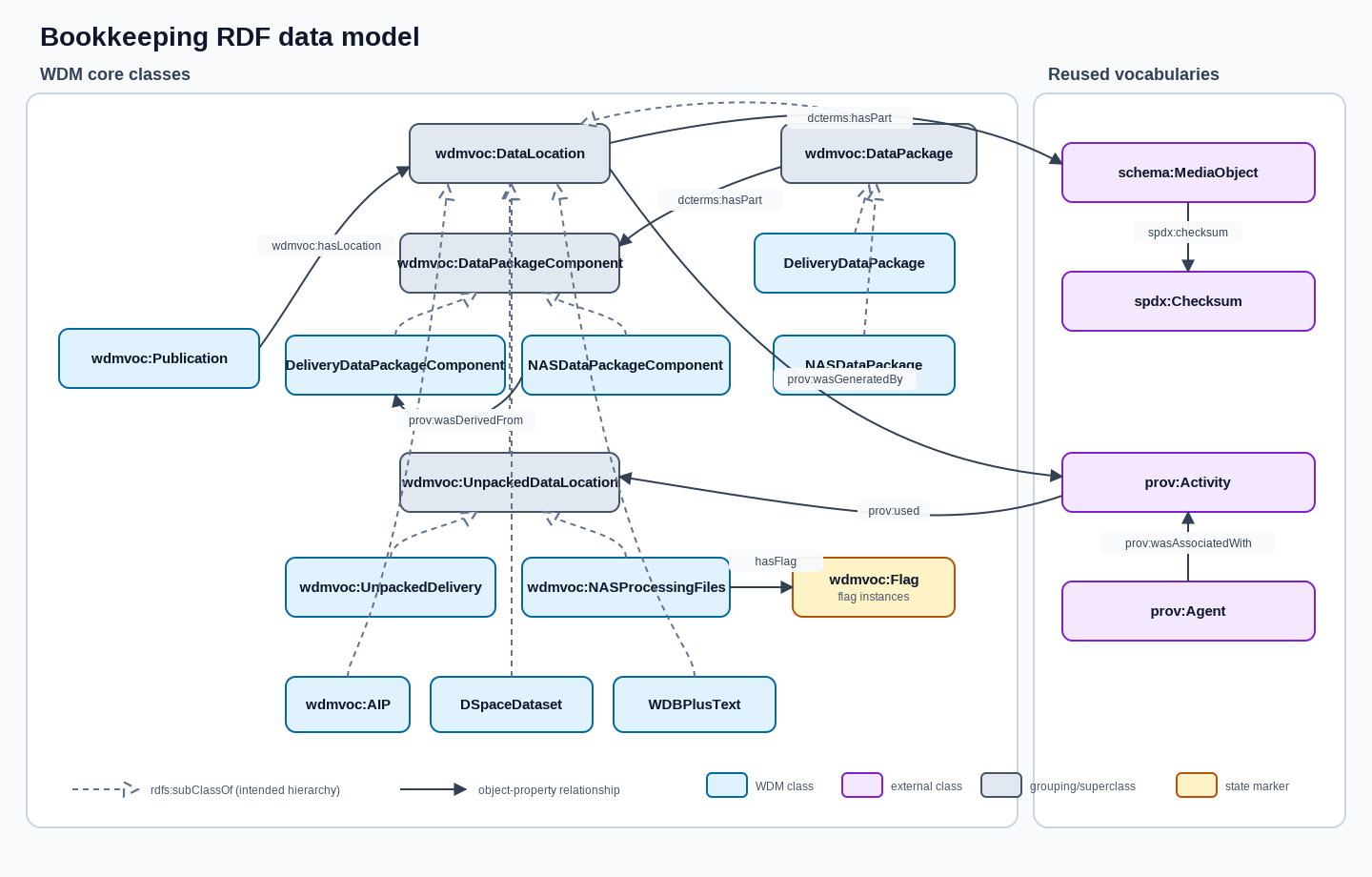
The figure uses hollow arrows for rdfs:subClassOf and labelled solid arrows for RDF properties. The inheritance tree is the intended conceptual hierarchy. The runtime graph does not depend on an RDF reasoner: concrete types and relations are written explicitly.
The most important path through the graph is:
Publication --wdmvoc:hasLocation--> DataLocation
DataPackage --dcterms:hasPart-----> DataPackageComponent
DataLocation --dcterms:hasPart----> schema:MediaObject
schema:MediaObject --spdx:checksum-> spdx:Checksum
A package component participates in both of the first two relationships. It belongs to exactly one logical publication in normal bookkeeping data, while the enclosing package can contain components for many publications.
Main classes
Publication
wdmvoc:Publication is the stable logical entity around which bookkeeping data is organized. It is identified with one or more dcterms:identifier literals. These normally include the internally generated UUID and a normalized provider identifier such as doi:10.5194/pb-4-1-2017. Optional identifiers used by later systems are attached to the publication, for example wdmvoc:toolboxID and wdmvoc:dspaceDatasetID.
The publication does not directly contain files. Instead, wdmvoc:hasLocation connects it to each representation of its data. A location IRI is normally constructed by appending a location UUID as a fragment to the publication IRI:
https://wdm.ulb.tu-darmstadt.de/uuid/{publication-uuid}#{location-uuid}
Data locations
wdmvoc:DataLocation is the conceptual superclass of locations at which the data for one independently processed publication can be found. Concrete locations use these common properties:
| Property | Meaning |
|---|---|
dcterms:date |
Date and time at which the location was registered. |
dcterms:hasPart |
Files recorded as part of the location. |
wdmvoc:contentPath |
Path within the base location or package. It may also name an inner ZIP file. |
wdmvoc:contentFilter |
Optional selector within the path. The implementation currently supports values beginning with regex:. |
wdmvoc:locationBaseAbs |
Stable absolute filesystem path or remote URL for an unpacked location. |
prov:wasDerivedFrom |
Earlier location(s) from which this representation was produced. |
prov:wasGeneratedBy |
Processing activity that created or updated the location. |
wdmvoc:hasFlag |
One or more operational or preservation-state flags. |
owl:deprecated |
Whether the representation has been superseded and should no longer be treated as current. |
schema:dateDeleted |
Actual deletion time; the Unix epoch is used as the sentinel for “not deleted”. |
The main concrete location classes are:
| Class | Purpose |
|---|---|
wdmvoc:DeliveryDataPackageComponent |
Data for one publication inside a shared package received from a provider. |
wdmvoc:NASDataPackageComponent |
Data for one publication inside a shared package stored on the backed-up NAS. |
wdmvoc:UnpackedDelivery |
A delivered source that contains exactly one independently processed publication. “Unpacked” refers to the data-model structure; the source itself may still be a ZIP file. |
wdmvoc:NASProcessingFiles |
The current working representation in the processing area. It carries pipeline routing and the operational flags used to obtain jobs. |
wdmvoc:AIP |
An archival information package in the long-term archive. Its identifier is recorded with dcterms:identifier, and its optional name with wdmvoc:nameOfAIP. AIPs are deliberately excluded when older locations are deprecated. |
wdmvoc:DSpaceDataset |
The publication's dataset representation in DSpace. Its DSpace object UUID is stored on the publication with wdmvoc:dspaceDatasetID. |
wdmvoc:WDBPlusText |
Intended vocabulary class for text converted to the WDB+ XML-based format. See the implementation note below about wdmvoc:DSpaceItem. |
wdmvoc:DataPackageComponent and wdmvoc:UnpackedDataLocation are grouping classes. The former covers packed per-publication locations; the latter covers locations that directly represent one publication and therefore do not need a shared package node.
The implementation also uses maintenance types such as wdmvoc:NASProcessingFilesCachingArtefact and wdmvoc:NASProcessingFilesRestartArtefact when old working-location records must be retained but excluded from normal job selection.
Data packages and package components
wdmvoc:DataPackage represents one archive containing data for multiple publications. It has two principal concrete types:
| Class | Purpose |
|---|---|
wdmvoc:DeliveryDataPackage |
A provider delivery stored outside the backed-up NAS package area, commonly at an SFTP URL. |
wdmvoc:NASDataPackage |
A package retained on backed-up NAS storage and used as a source for further processing. |
A package carries a UUID in dcterms:identifier, its stable archive path or URL in wdmvoc:packageLocation, and lifecycle metadata in owl:deprecated and schema:dateDeleted. It links to every component using dcterms:hasPart.
The component, rather than the package, is linked to a publication with wdmvoc:hasLocation. This is what permits one archive to contain many publications:
DeliveryDataPackage ── dcterms:hasPart ──> DeliveryDataPackageComponent
                                                   ^
                                                   |
                                      wdmvoc:hasLocation
                                                   |
                                              Publication
The component selects its files inside the shared package using wdmvoc:contentPath, wdmvoc:contentFilter, or both. The package's wdmvoc:packageLocation is found by following the inverse dcterms:hasPart relation from the component. The component does not repeat wdmvoc:packageLocation in the RDF.
For example, generic_delivery_sorter.ttl contains a DeliveryDataPackage at the SFTP URL .../digital-02-02.zip. It has a component for DOI 10.3390/digital2020018; that component uses contentFilter "regex:^digital-02-00018.". The same publication is linked to that delivery component, a derived NASDataPackageComponent, and a NASProcessingFiles location. prov:wasDerivedFrom connects the NAS component to the delivery component.
Files and checksums
Each registered file is a schema:MediaObject linked from its location with dcterms:hasPart. Its IRI is location-scoped and ends with the relative file path. polymat:hasPath records that relative path as a literal.
The file points through spdx:checksum to an spdx:Checksum resource. SHA-256 checksum resources use a urn:sha256:{digest} IRI and carry:
spdx:algorithm spdx:checksumAlgorithm_sha256 ;
spdx:checksumValue "..."^^xsd:hexBinary .
This separation allows the same checksum resource to be reused when identical content appears in more than one location.
Agents, activities, and workflow routing
The graph uses prov:Agent for workflow modules and prov:Activity for their executions. A versioned agent is connected to its unversioned module with prov:specializationOf. Activities record prov:wasAssociatedWith, prov:startedAtTime, and prov:endedAtTime; nested activities are connected with dcterms:hasPart.
Processing provenance is expressed from both directions used by PROV-O:
- an activity
prov:usedits input location or files; - a new or updated location/file
prov:wasGeneratedBythe activity; - a successor location
prov:wasDerivedFromits source location.
For wdmvoc:NASProcessingFiles, xkos:previous and xkos:next point to module agents and represent workflow routing. rico:hasOrHadController links the location to its pipeline. These routing relations, together with the Active flag and suspension date, drive job selection.
Flags
General behavior
wdmvoc:Flag is a class of marker resources. Individual flags are instances, not subclasses, and locations receive them through wdmvoc:hasFlag. They are lightweight annotations used by the orchestration code when choosing, pausing, superseding, or preserving locations.
Flags are not modeled as a single-valued state machine. A location can have several flags at once, and RDF/OWL constraints do not make flags mutually exclusive. Their meaning comes from the code that writes and queries them. They also serve a different purpose from the two lifecycle properties:
owl:deprecated truemeans that a location or package has been superseded and is no longer current;- a non-epoch
schema:dateDeletedmeans that its stored content was actually removed; wdmvoc:hasFlagcarries workflow or preservation state that may coexist with either lifecycle value.
Operational flags
| Flag | Meaning in the current implementation |
|---|---|
wdmvoc:Active |
Marks the current NASProcessingFiles location eligible for normal job selection in a pipeline. When a newer working location becomes active, older active locations in that pipeline are deprecated and lose this flag. |
wdmvoc:Queued |
Marks a new working location waiting in the special -inLTA pipeline. It is used instead of Active when a prior location of the publication already carries InLTA; older queued locations are deprecated and marked Outdated. This flag is used by the code although it is absent from the supplied vocabulary snapshot. |
wdmvoc:StopProcessing |
Stops ordinary automatic selection after a module reports a “do not process” result or an integrity check fails. Stopped jobs can be requested explicitly for diagnosis or continuation. A later update removes the old stop marker unless it is deliberately re-added. |
wdmvoc:NeedsManualIntervention |
Intended to mark a location that requires manual handling. The update logic removes this marker when processing resumes. See the naming inconsistency below: job selection currently queries wdmvoc:ManualIntervention. |
wdmvoc:Outdated |
Marks an older active or queued working representation that was superseded by newer data. The implementation normally adds it while also setting owl:deprecated true. |
wdmvoc:InLTA |
Indicates that processing has advanced to long-term-archive ingestion. The presence of this flag changes later incoming data from the default pipeline to the -inLTA queue because a simple restart could invalidate the archived state. Cleanup routines preserve this flag. |
wdmvoc:LTAVerified |
Indicates that the exported archival derivative passed the long-term-archive derivation/hash check. Once present on a publication's processing location, delivery and NAS-package source locations may be deprecated. Cleanup routines preserve this flag. |
wdmvoc:suspendedUntil complements the flags. It is an xsd:dateTime on NASProcessingFiles; normal job selection skips a location while this timestamp is in the future, unless suspension is explicitly ignored.
Vocabulary flags without current runtime behavior
The vocabulary snapshot also declares the following wdmvoc:Flag instances, but no producer or consumer for them was found in the current repository or supplied example data:
| Flag | Vocabulary-level intent / status |
|---|---|
wdmvoc:Removed |
Name suggests removed content; no runtime semantics are currently established. Physical deletion is represented authoritatively by schema:dateDeleted. |
wdmvoc:Finished |
Name suggests completed processing; no runtime semantics are currently established. |
wdmvoc:PackageEntryIncomplete |
Name suggests incomplete package registration or content; no runtime semantics are currently established. |
wdmvoc:QueuedForReconversion |
Name suggests routing into a reconversion queue; no runtime semantics are currently established. |
wdmvoc:QueuedForReclassification |
Name suggests routing into a reclassification queue; no runtime semantics are currently established. |
These terms should not be treated as enforced workflow states until their writers, readers, and transition rules are defined.
Compact example
The following shortened Turtle illustrates the core pattern. Identifiers and paths follow the supplied example data, while ellipses replace UUIDs and omitted file lists.
@prefix dcterms: <http://purl.org/dc/terms/> .
@prefix prov:    <http://www.w3.org/ns/prov#> .
@prefix wdmvoc:  <https://purl.ulb.tu-darmstadt.de/wdm/voc#> .

<urn:publication> a wdmvoc:Publication ;
    dcterms:identifier "doi:10.3390/digital2020018" ;
    wdmvoc:hasLocation <urn:delivery-component>,
                       <urn:nas-component>,
                       <urn:processing-location> .

<urn:delivery-package> a wdmvoc:DeliveryDataPackage ;
    wdmvoc:packageLocation
        "sftp://u301496-sub12.your-storagebox.de:22/digital-02-02.zip" ;
    dcterms:hasPart <urn:delivery-component> .

<urn:delivery-component> a wdmvoc:DeliveryDataPackageComponent ;
    wdmvoc:contentFilter "regex:^digital-02-00018." ;
    dcterms:hasPart <urn:delivery-file> .

<urn:nas-component> a wdmvoc:NASDataPackageComponent ;
    prov:wasDerivedFrom <urn:delivery-component> .

<urn:processing-location> a wdmvoc:NASProcessingFiles ;
    wdmvoc:locationBaseAbs "/mnt/nas-tmp/.../digital-02-00018" ;
    wdmvoc:contentPath "current-module" ;
    wdmvoc:hasFlag wdmvoc:Active .
Implementation notes and known inconsistencies
NOTE: This points have been noted down as bokkeeping issues in the harvesting repo. However, their priority is currently pretty low, so they have not been fixed yet.
- The supplied 2025-09-22 vocabulary is a short working snapshot, not a complete machine-valid ontology. It contains typographical issues (
owl:class,rdfs:rdfs:subClassOf, and the malformedQueuedForReclassificationsubject) and explicitly notes missing location properties. The implementation and example graphs were therefore used to complete this documentation. - The vocabulary conceptually declares
wdmvoc:DataPackageas a subclass ofwdmvoc:DataLocation. In the Python implementation,DataPackageis a separate container class, and package nodes are not linked from publications bywdmvoc:hasLocation; their component nodes are. - The vocabulary and update code use
wdmvoc:NeedsManualIntervention, while job-selection queries usewdmvoc:ManualIntervention. Until this is normalized, manual-job queries may not find locations written with the vocabulary term. - The vocabulary snapshot names
wdmvoc:NASDataPackageComponentCachingArtefact, whereas current maintenance code writeswdmvoc:NASProcessingFilesCachingArtefact. These should be regarded as distinct terms until the vocabulary and implementation are aligned.