Workflow
Overview
During the first funding phase (01.01.2023 - 30.06.2026), the WDM project focused on harvesting open-access journal articles. Figure 1 shows the workflow developed, with the blue boxes at the top representing its main stages. Dark blue boxes represent steps in the workflow that are functioning as prototypes, whereas light blue boxes represent steps that are still under development. While the steps 'Acquisition decision' and 'Rights clearance, contact to publishers' are primarily organisational, the steps 'Harvesting' through 'TU storage ingest TEI/XML' are primarily technical. Figure 1 shows the technical workflow steps in detail in the lower part.
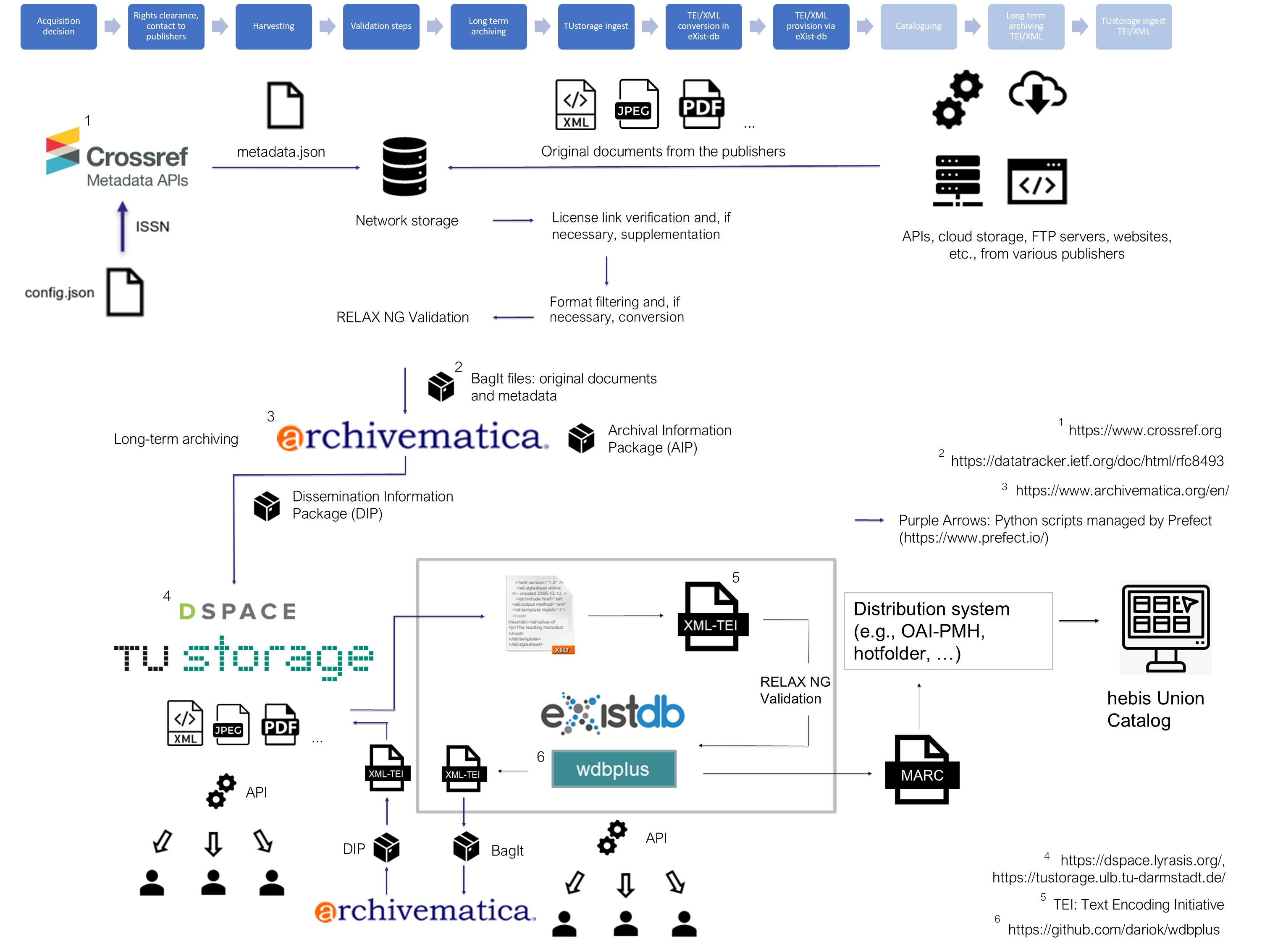
Figure 1: Schematic overview of the organizational and technical steps in the WDM workflow.
Organizational Workflow
The workflow begins with a decision on acquisition by a subject librarian. In a subsequent rights clearance process, it is checked whether the desired journals are in fact available under open-access licences. The rights and licensing information collected during this phase determines how openly the processed documents can be made available later on. WDM adheres to the principle of making the resulting data as open as the licence terms of the original documents permit.
Following the rights clearance process, the literature provider is asked whether the requested journals are available in XML format, ideally alongside PDF files, figures, and supplementary information files. They are also asked which delivery method can be used to download or harvest the article files automatically. In the technical part of the workflow, which is explained in the next section, a provider-specific harvesting script is then written that can automatically download the article files via the delivery system provided by the publisher.
Technical Workflow
The technical workflow for harvesting a journal begins by adding its ISSN and some additional information to the central workflow configuration file config.json. The next step involves downloading the Crossref metadata for all articles published in this journal into the defined folder structure of a local network storage. A metadata.json file with the metadata is created for each article in the journal on the network storage. A provider-specific harvesting script then downloads all available files for each article. Ideally, these comprise the full text of the article in a (publisher-specific) XML format, along with associated figure and supplementary information files. PDF full texts are also harvested.
Currently, the workflow only processes articles that are provided by the publisher in an XML format. Articles without XML full text are harvested but not yet processed.
The next step involves validation checks that examine the available files for the following properties:
- Does the XML full text contain a licence link and, if so, is this identical to the licence link in the Crossref metadata?
- Are the formats supplied by the publisher suitable for long-term archiving? If not, are there already conversion scripts in the workflow that convert these formats into formats suitable for long-term archiving?
- Can the XML documents supplied by the publisher be converted later in the workflow into the WDM-specific TEI/XML target format? (This is checked by a Relax-NG validation.)
Articles for which the answer to any of the above questions is ‘no’ are initially held back in the workflow. The following steps are only carried out for articles that have successfully passed all validation checks.
A ZIP file compliant with the BagIt standard is created for each article. This ZIP package contains key metadata for the article as well as all files that could be harvested from the provider for that article.
These BagIt packages are then imported into the long-term archiving system, Archivematica. There, the BagIt packages are converted into Archival Information Packages (AIPs) and archived for the long term. Work then continues using a copy of this data, which is exported from Archivematica in the form of so-called ‘Dissemination Information Packages’ (DIPs). As with the AIPs, the DIPs also contain all article files that could be downloaded from the provider. These are imported into the WDM project’s DSpace repository, TUstorage. There are two reasons for this:
- The files are accessible to anyone who is interested as soon as they are stored in TUstorage.
- TUstorage serves as a data source for the eXist XML database, which downloads the full texts from there, converts them to TEI/XML and subsequently makes them publicly available via its own API.
This conversion to the TEI/XML target format takes place within the eXist database using an XSLT script. The success of the conversion is verified by means of a further Relax-NG validation before the data is made available via a publicly accessible API. The API is part of the wdbplus presentation system installed in the eXist database.
The next step planned is to convert the metadata for each article into MARC format and deliver it to the head office of the hebis common library network via a suitable delivery system, so that the metadata can then be imported into the hebis union catalogue.
It is also planned to import the converted TEI/XML documents into Archivematica and subsequently into TUstorage.